
A guide for business owners in Serbia and the region
If you are launching or improving an online store, it is essential to enable secure, fast and simple online payments. You are probably wondering:
- How do I choose the best payment gateway, and how does it work?
- Which payment options should I offer?
- Do I need a dedicated team for the integration (the technical connection), or can I do it myself?
- What do I need to do to make payments secure?
- How do I handle fiscalization?
- What are the costs, and what should I look out for when choosing a provider?
If you are looking for answers to these questions, this guide is for you. In this article, we walk you through all the key topics you need to know about online payments – clearly, practically and without unnecessary technical jargon.
What Is an Online Payment and How Does It Work?
An online payment is a process in which a customer pays for a product or service over the internet, most often using a card, a digital wallet or a bank transfer.
Although it seems simple at first glance – a click on the “Pay” button – behind every successful transaction there is a series of participants and technological processes that, within a few seconds, allow the money to travel safely and quickly from the customer to the seller.
Who Are the Key Participants in the Online Payment Process?
- Customer – the person who wants to buy a product or service online and who initiates the payment (unless a subscription model is chosen, in which case the payment is initiated automatically, based on previously given authorization).
- Online store (merchant) – the company or entrepreneur that sells goods or services and wants to collect payments online.
- Internet Payment Gateway (payment processing system) – the technology that connects the online store with financial institutions and enables secure data transfer and execution of the transaction.
- Bank (or card issuer) – the financial institution behind the customer’s card that approves the transaction.
- Merchant’s bank (recipient of funds) – the financial institution that receives payments into the merchant’s account.
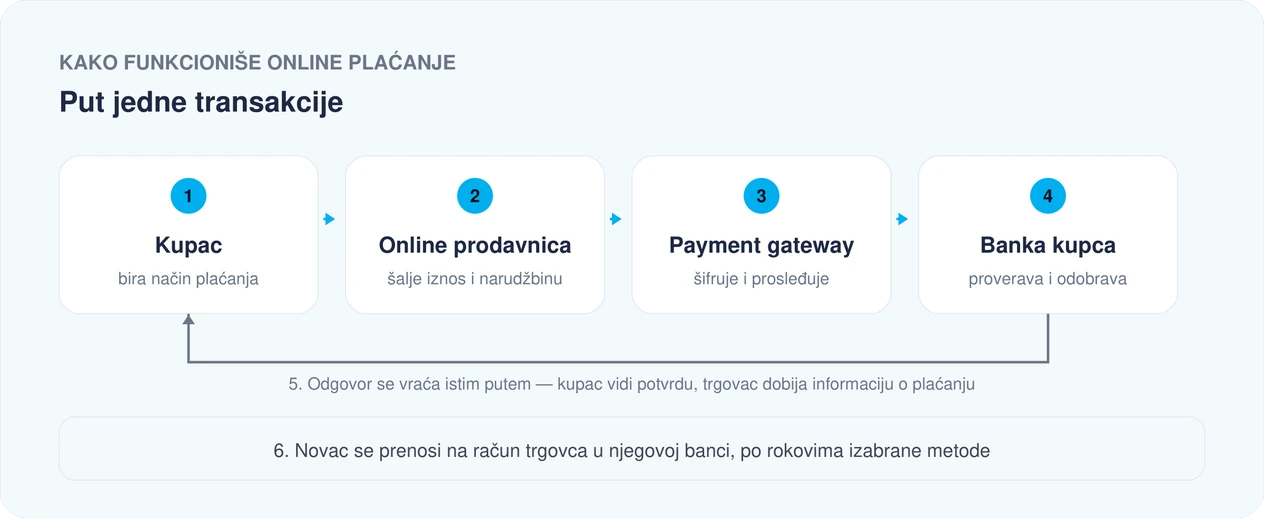
What Happens When a Customer Clicks “Pay”?
- The customer chooses a payment method – e.g. by card, via a digital wallet, by direct bank transfer (IPS), with installment payments or with another option the store offers.
- The customer enters the required details or confirms the payment
- If paying by card, they enter the card number, expiration date and CVV, or use an already saved card (with tokenization).
- If paying with a digital wallet (Apple Pay, Google Pay), they confirm the payment with a fingerprint, face or passcode, without re-entering any details.
- If they choose IPS, i.e. instant payment, the bank’s app or a scanned QR code allows confirmation without entering card details.
- The payment data or confirmation is forwarded to the payment processing system (payment gateway), which enables secure transfer of information and validation with the bank.
- The bank or payment system checks and approves the transaction – it assesses validity, available funds and security risks.
- The payment gateway returns information on the outcome of the transaction – the customer sees a confirmation on the website, and the merchant receives the payment information.
- The money is transferred in line with the selected method and transfer timelines.
In practice, all of this takes just a few seconds. Thanks to security standards, tokenization and regulations, online payments have become reliable and secure for all parties involved.
Which Online Payment Options Should You Offer Your Customers?
Choosing payment methods is not just a technical question – it is a business decision that directly affects your sales. There are several payment methods, and people are often unsure whether they have to offer all of them or which one is the most effective. Here are the most important options you should know about:
Card Payments – The Foundation of Every Online Business
Cards are still the most commonly used online payment method, both locally and globally. The customer enters their details or uses a saved card, and the process takes place in real time. Without card payments, an online store is practically non-functional.
Pay by Link – Flexibility for Direct Sales
The customer is sent a personalized payment link, ideal for social media, messages or emails. Great for small businesses, one-off purchases or direct sales.
IPS Payments – Instant Account-to-Account Transfer
The customer scans a QR code or uses the instant transfer option through their bank. The transaction is executed immediately, with no waiting and no fee on the customer’s side. In Serbia, IPS is becoming the standard for payments.
Installment Payments – Encouraging Larger Purchases
Allows customers to buy now and pay later, through partner banks or BNPL services. Increasingly popular among young people and in sectors such as electronics and fashion.
Optional: Digital Wallet Payments (Apple Pay, Google Pay) – Fast and Secure
Customers confirm the payment on their device, without entering card details. Well suited to mobile users. It is becoming the standard in the EU and the US and is growing in Serbia and the region as well. It is easier for customers because they don’t have to enter their card numbers every time.
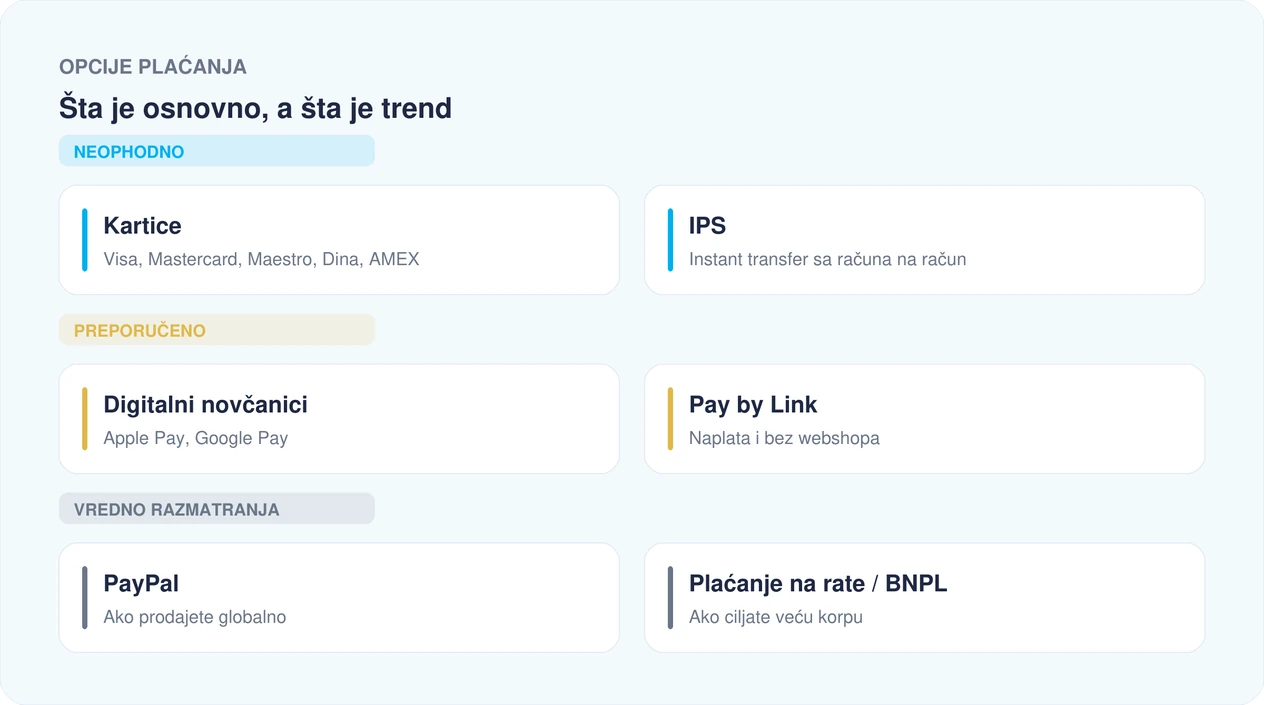
What Is Essential and What Is a Trend?
- Essential: card payments + IPS
- Recommended: digital wallets + Pay by Link
- Worth considering: PayPal (if you sell globally) + BNPL (if you aim to increase cart value)
Online Payment Security: What You Need to Know
When you launch an online store, security must not be an afterthought. Although there are numerous technical solutions that protect both you and your customers, it is important to understand who is responsible for what and how, together, you build a secure sales process.
The Role of Your IT Company – Website Security Starts with You
Your IT company or team is responsible for protecting your website and your users’ data. The minimum they should provide:
- SSL certificate – basic protection for secure data transfer (so the address starts with “https://”)
- Updated platforms and plugins – regular website maintenance prevents misuse
- Security practices – admin panel protection, strong passwords, access rights
- CAPTCHA – it is also useful to have this type of verification as an additional protection method, especially when users are allowed to buy without registering on the website (as guests)
The IT company takes care of the website, but it does not process payments. That is the job of the payment processing system (the payment gateway provider).
The Role of the Payment Processing System: Payment and Data Security
When the customer reaches the payment step, the company that processes your payments (your payment gateway) comes into play. It is responsible for ensuring that the payment is:
- Tokenized – instead of storing card data, a token is used that has no value to fraudsters
- Protected in line with the PCI DSS standard – the global standard for card payment security
- Compliant with local and international regulations
AllSecure uses tokenization and holds PCI DSS Level 1 certification – the highest level of security standard in the industry.
Fraud and Risk Management: What Is Your Role?
Completely eliminating risk is not possible, but it is important to have a system for managing it.
- Define risk thresholds – e.g. multiple orders from the same IP address or suspicious cards
- Define a block list – a database containing information about suspicious IP addresses, cards, devices and users
- Use smart risk assessment tools – some payment processing systems have built-in monitoring tools
- Educate your team to recognize suspicious activity and respond in time
Security is a shared responsibility: the IT team, the payment gateway, the bank and you, as the merchant, form a chain of protection.
Once you have defined your payment methods, ensured security and set up your payment collection system, the next logical question is – how do you issue receipts to customers correctly and easily? Whether you sell through a webshop, a payment link or an app, fiscalization is an important step you must not overlook. That is why below we explain what you need to know about fiscal receipts and how you can make your day-to-day operations easier.
Fiscalization and Legal Obligations in Online Sales
If you sell products or services to individuals in Serbia, in most cases you are required to issue a fiscal receipt, regardless of whether the sale takes place in person, through a webshop or via a payment link.
When Are You Required to Fiscalize?
- When you sell to end customers (individuals)
- When payment is collected electronically (cards, IPS, wallet)
- When you operate in lines of business that are subject to fiscalization
If you are unsure whether your sales must be fiscalized — consult your accountant or tax advisor.
Can Fiscalization Be Automated?
Yes. For online stores, especially those with a larger number of transactions, sending fiscal receipts manually is not practical. That is why there are solutions that allow the:
- fiscal receipt to be generated automatically after a purchase is completed,
- sent to the customer by email or through the system you use,
- and recorded in the tax system.
This not only saves time but also reduces the chance of errors.
How Does It Work with Us?
If you use AllSecure for payments and meet the necessary technical requirements, through our partnership with Elefakt you can connect your online store and fiscal system so that:
- the fiscal receipt is generated automatically after payment,
- it is sent to the customer without any additional action on your part,
- everything works both for webshops (e.g. WooCommerce, Shopify, Wix) and for Pay by Link.
This is especially useful for merchants with higher turnover or those who use multiple sales channels.
If you need receipt fiscalization services, contact Elefakt by email at [email protected] and in the email subject line enter ALLSECURE to identify the partnership.
Important to know: in most cases, fiscalization software is contracted and paid for separately. The same applies to integration with an online store or payment collection system. The price depends on the provider, the integration method and the scope of functionality you need. Before deciding on a solution, check all the terms with your chosen partner.
Once you have defined your payment methods, ensured security and sorted out fiscalization, the time comes to technically connect online payments to your sales platform. This part is usually handled by your technical team or IT partner, as it involves implementing a solution that makes everything work seamlessly – from choosing the connection method, through testing and meeting the requirements of the bank and card schemes, to secure operation in practice. Below we explain the most common options and how to find the solution that suits your business.
How to Enable Online Payments on Your Website?
When it comes to technically connecting online payments to your store or website, in practice there are three most common routes: using ready-made plugins, connecting via API integration, or simply sending a payment link (pay by link). The choice depends on which platform you use, what business model you have set up and how many transactions you expect.

Ready-made plugins – for popular platforms such as WooCommerce, Shopify or Wix, there are usually ready-made modules that enable quick and easy integration. It is important to note that the IT team maintaining your website is responsible for the implementation and any custom changes.
API Integration – for more complex, custom websites and apps, the technical team uses an API to connect the payment system directly to your platform and adapt the functionality to your needs.
Payment links (pay by link) – this is the simplest way to receive payments, especially if you don’t have a webshop. You can create payment links directly in the admin area of your payment gateway provider (for example, in the AllSecure user dashboard) and send them to customers by email, SMS or other channels.
AllSecure offers all of these options and also provides technical support during implementation. However, it is important to know that the final integration and maintenance of the system remain the responsibility of your IT team or partner.
Now that you know which payment options are available and how to implement them technically, the next important question is: how do you choose the right payment provider? There are many providers on the market, from global players to regional specialists, and each offers different services, levels of security, pricing and support.
How to Choose the Right Payment Provider?
Choosing a payment processing system (payment provider) is one of the most important decisions for your online business, because it directly affects the security, speed and quality of payments, as well as your customers’ satisfaction. Here are the key factors to consider:
1. Currency and Market Coverage
It is important that the system processing your payments supports the currencies and countries in which you operate, especially if you have international customers or plan to expand your business.
2. Security and Compliance with Standards
The provider should have a high level of security, such as PCI DSS certification, data tokenization and additional fraud protection measures.
3. Support for Different Payment Methods
Be sure to check whether cards, digital wallets (Apple Pay, Google Pay), pay by link options, installment payments and other methods that matter to your customers are supported.
4. Flexibility in Business Models
Make a list of what is important and necessary for your business, and then check whether the payment provider supports the functionalities that matter for your business. These may include some of the following:
- recurring payments (automatic billing for subscriptions),
- pre-authorization (reserving funds with the option to later approve or decline the payment – e.g. when you want to check stock levels first),
- simple refunds directly from the user portal,
- detailed analytics and report exports that help you track sales performance.
5. Ease and Speed of Integration
A good payment provider will offer you plugins for popular platforms and a simple API, along with technical support during integration.
6. System Reliability
It is important that the system is stable and has mechanisms for automatically rerouting payments if there is a problem with one of the banks or services. For you and your customers, this means fast, reliable and secure transactions.
7. Customer Support and Service
Fast and accessible customer support can save you a lot of time and trouble in critical situations. Choose a provider with strong, active, local customer support that works in and covers your time zone.
AllSecure is a solution distinguished by its cooperation with numerous banks in Serbia and the region, providing reliability and security. This means that if there is a problem with one bank, the system can automatically reroute the payment through another (if you choose that option), so that transactions succeed without interruption. Also, if you run an international business, AllSecure can support different currencies and markets, giving you flexibility and local support in the region and in Europe.
How Much Do Online Payments Cost and What Do the Costs Depend On?
The price of online payments is not universal and depends on several factors – your business model and the market you operate in, the services and functionalities you decide to use, and the bank you work with. That is why it is important to share as much information as possible with your payment provider about your business, planned turnover and the markets you operate in, so that you receive a realistic offer tailored to you and your business model.
Costs consist of a fixed and a variable part. Some fixed costs are charged only at the start (connecting to the system and the like) and amount to around €100, while others are charged monthly, based on the number of transactions and other parameters. It is best to walk through a simple example.
Online Payment Costs: An Example
On the market, fees for accepting online payments typically range between 1.5% and 3.5% per transaction for banking services, plus an additional fixed fee of around €0.25 per transaction. Let’s walk through a practical example to make this clearer.
Imagine you have 100 online orders per month, and the average cart value is 30 €. That brings you €3,000 in gross revenue.
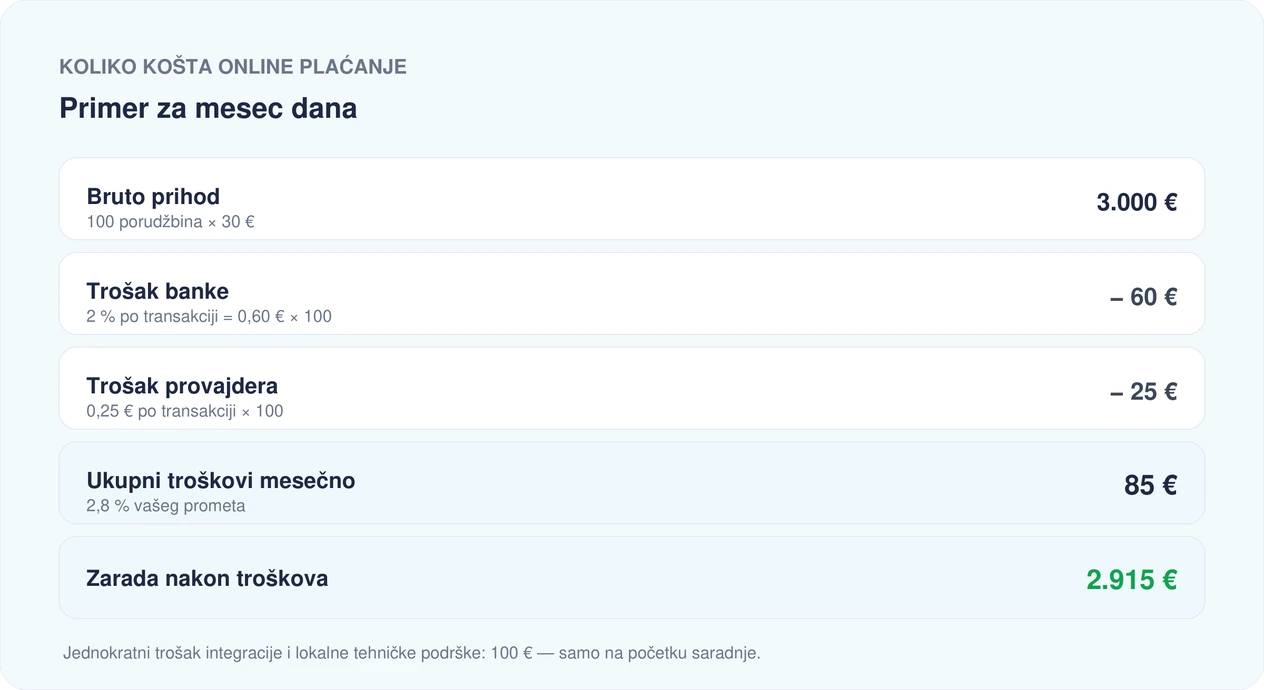
Bank cost (percentage per transaction):
- assumed fee: 2%
- 2% of €30 = €0.60 per transaction → 100 transactions × €0.60 = 60 €
Payment provider cost:
- fee per transaction: €0.25 → 100 transactions × €0.25 = 25 €
Total monthly costs: 60 + 25 = €85
Earnings after all costs: €2,915
The one-time cost of integration (connecting to the system) and local technical support is €100. It is paid once, at the start of the cooperation, and covers the costs of connecting your e-commerce website to the online payment system.
What does this mean for you?
- the processing cost (in this example) is only 2.8% of your turnover,
- all transactions are collected without risk,
- no cash, no delays, no uncertainty.
AllSecure is not just a payment collection tool but a partner that helps you earn more, with less risk and less paperwork. Would you like us to run the numbers together for your business? Get in touch.
What Do Online Payment Costs Depend On?
The example above uses average costs, but actual costs vary depending on:
- the choice of payment provider and bank,
- the type of card (debit, credit, international),
- added services such as subscriptions, pre-authorization, instant payments (IPS),
- the number of completed transactions,
- options for wallets, BNPL and installments, which may carry separate fees,
- the number of refunds and the related costs,
- monthly fixed fees and costs for reporting and analytics.
SMART MOVE: ask for a tailored offer. By providing precise information about volume, markets and functionalities, you make it easier for the provider to propose the optimal model, one that minimizes costs while covering all your needs.
Now That You Have the Full Picture…
In this article, we have gone through all the key steps together, from understanding how online payments work, through choosing payment methods, security standards and legal obligations, to technical solutions and costs.
If you would now like to find out whether we are a good partner for your online payments and whether we can meet your needs, read on.
Ready to Accept Online Payments? The Process of Working with AllSecure

1. Filling Out the Online Form: Information About Your Business
The first step is simple: fill out the form on our website and answer questions about your business. Our representative will contact you within 24 hours.
2. Choosing a Bank and Communicating with the Bank
If you already have a bank – great. If not, you choose one or more banks that suit you best and that are licensed to accept online payments (an acquiring license). AllSecure then takes over communication with the bank so that together we can go through the approval procedure that allows you to collect payments online. Depending on the payment model and the technical solution, this step can take from 5 to 10 business days.
3. Offer and Decision
Once the bank approves the cooperation, AllSecure sends you a specific offer in which you can clearly see all the costs and terms for processing online payments. We are here for you if you have any questions or concerns, and the decision to proceed is yours.
4. Signing the Contract
Once you decide to work with us, the next step is signing the contract and formalizing the cooperation.
5. Technical Integration and Support
Our technical team guides your IT team or external IT partner through the process of integrating online payments into your website – from the technical connection to meeting all the criteria required for successful completion. This phase can take up to 15 business days, depending on the complexity of the website and how quickly your IT team works.
6. Online Payments Are Live – Congratulations!
Once the integration is complete and tested, your online store is ready to accept payments securely and reliably.
If you want to launch or improve online payments in your business, fill out the form on our website and our team will contact you within 24 hours. We will be happy to work with you to find the best solution for your online business.